Services
Integrations and APIs
Accounting, ERP, CRM, online shop, warehouse, banks, couriers, government platforms: we connect them so data is entered once and reaches every place it is needed.
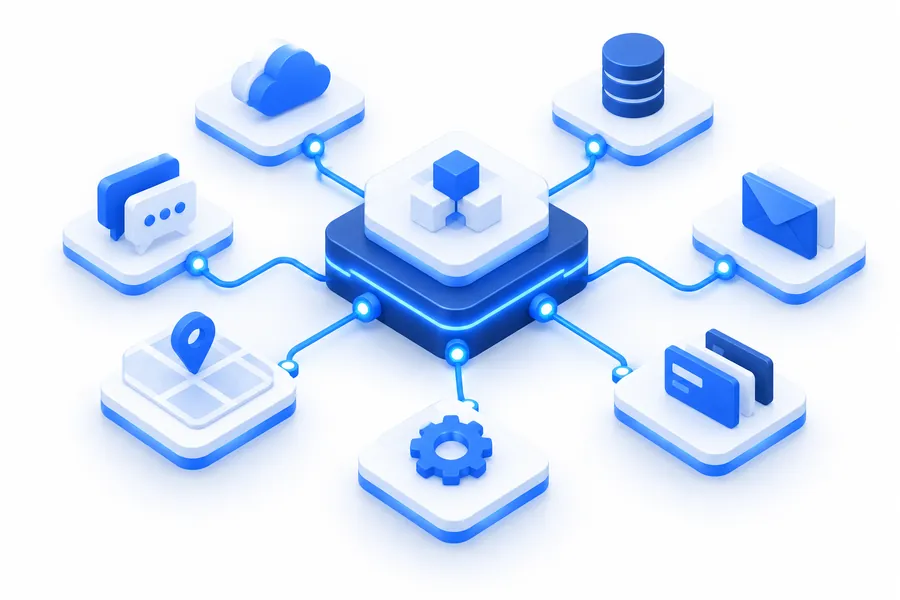
Islands of data
Most companies run several good systems that never talk to each other. People end up acting as the integration: exporting, copying, retyping and checking.
Each manual hand-off takes time and causes errors. An integration replaces it with a reliable, monitored connection.
What we build
System-to-system integrations
Two-way synchronisation between accounting, ERP, CRM, e-commerce and warehouse systems.
Public and private APIs
Well-documented APIs that let partners and your own apps work with your data in a secure way.
E-invoicing and government platforms
Connections to national e-invoicing and reporting systems in the countries where you operate.
Payments and banking
Payment gateways, import of bank statements and automatic reconciliation.
Notifications
SMS, email, WhatsApp, Telegram and Viber messages sent when events happen in your systems.
How the pieces connect
Connects to
- Accounting and ERP
- E-shop and CRM
- Banks and couriers
Integration layer
Used by
- Synchronised systems
- Partner access
- Alerts and logs
Typical features
Reliability
- Automatic retries and error queues
- Monitoring and alerts when a connection fails
- Idempotent processing, so nothing is recorded twice
Security
- API keys and OAuth 2.0
- Encrypted traffic
- Access restricted to the data each partner needs
Transparency
- Log of every message exchanged
- Dashboard showing sync status
- Clear API documentation (OpenAPI)
Typical scenario
An example of the type of project we build. It does not describe a specific client.
Situation
An online shop takes orders on its website, while stock sits in the warehouse system and invoices in accounting. Staff copy each order by hand.
What we build
An integration that passes every order to the warehouse, updates stock on the website, creates the invoice in accounting and sends the customer the tracking details.
Result
Orders handled without retyping, stock always correct online, and customers kept informed automatically.
How the project unfolds
Inventory of systems
Which systems, which data, in what direction and how often.
Technical check
What each system allows: API, files, database access, limits.
Mapping and rules
Field-by-field mapping and rules for conflicts and errors, agreed with your team.
Build and test
Integration built and tested with real data in a test environment.
Go live and monitor
Gradual switch-over with monitoring and alerts from the first day.
What you get
- Working, monitored integrations
- API documentation
- Error handling and alerting
- Source code and the rights to it
- Runbook for your team
Technologies we use
- REST and SOAP
- Webhooks
- OAuth 2.0
- Message queues
- OpenAPI documentation
- Node.js and Python
Questions about this service
What if a system has no API?
There is usually another route: file exchange, a database connection or scheduled exports. We pick the most reliable one.
What happens when one system is down?
Messages wait in a queue and are processed once it is back. You receive an alert, and nothing gets lost.
Can you connect to national e-invoicing systems?
Yes. We build connections to national e-invoicing systems, covering validation, submission and reading the responses.
Who maintains integrations when systems update?
We can, under a support plan. APIs evolve over time, and monitoring helps spot changes early.
Related services
All services-
Custom software development
Internal systems, portals and apps built around the way your company really works.
-

AI automation and AI agents
Documents, data entry, answers and reports handled by AI, with people staying in control.
-
Cloud and infrastructure
Fast, stable and scalable hosting for your applications.

Let's discuss your project
Explain what you need in a few lines. Within one business day we get back to you with questions and the next steps.
Request a quote